

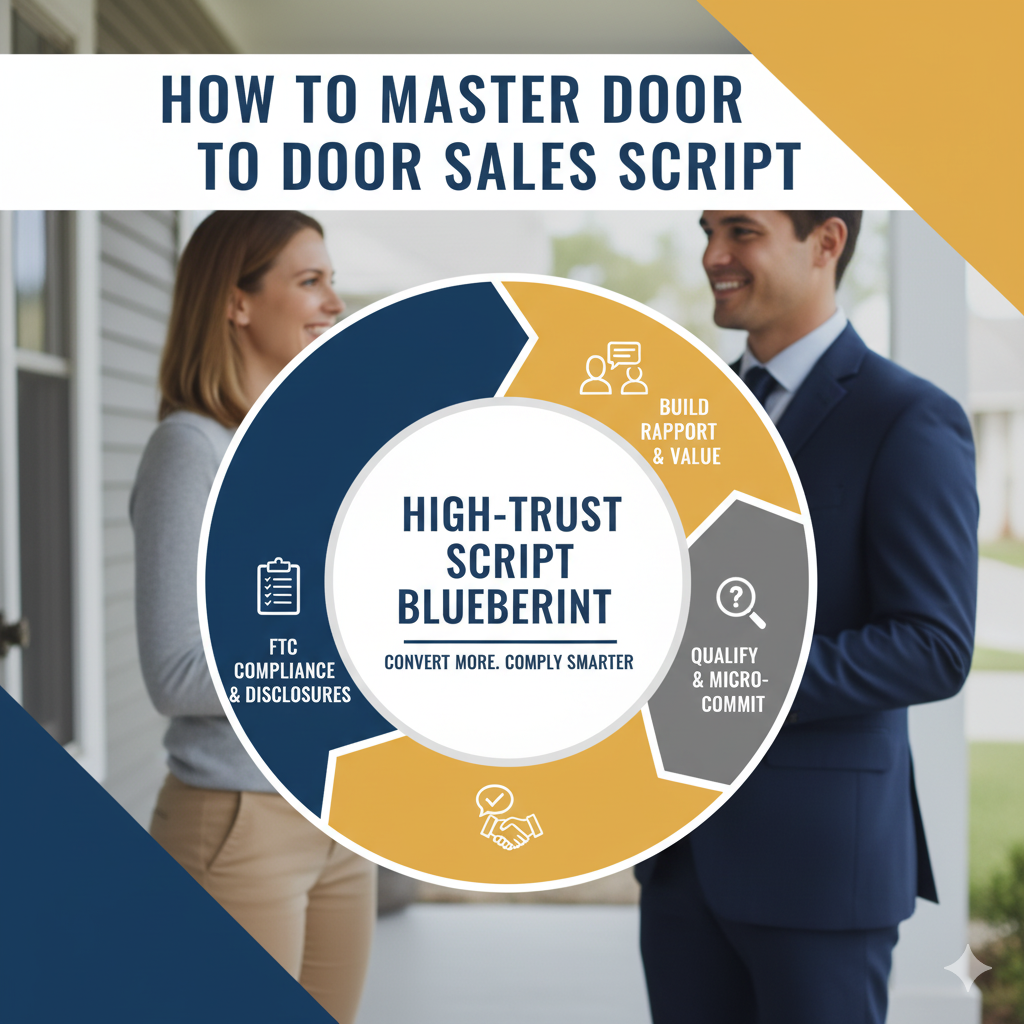
If you’ve ever felt that pit in your stomach walking up to a doorstep, you know the painful reality. Homeowners are busy, skeptical, and wary of pressure. Let’s be real—most new reps freeze at the first objection and end up burning entire blocks without a single set. Why? Because the scripts they use sound robotic and trigger an immediate shut-down response.
Here’s the thing: you get one shot at the door. Blow it, and the whole street watches. You need a script that acts like a conversation framework, not a monologue, and one that absolutely prioritizes compliance. A high-trust approach is the only way to succeed in today’s neighborhood.
As Zig Ziglar famously said, “You can have everything in life you want, if you will just help other people get what they want.”
Key takeaways
- A door to door sales script must be situational and compliant, not a set of memorized lines.
- Qualify fast, deliver one sharp value statement, then ask for a micro-commitment.
- Use evidence and neighbors’ outcomes to build trust, not pressure.
- Measure first-minute engagement, objection patterns, and set rates—not just closes.
Interest — diagnose and educate
We’ve all seen it: a rep who works twelve hours just to limp home with two sets. When the effort doesn’t match the output, the failure is usually baked into the script itself and often made worse by poor sales training that never equips the rep with the right approach.
Why door scripts often fail: a root-cause breakdown
The breakdown happens when the script ignores the buyer’s psychology:
- Misaligned opener: The rep talks about the product, but the homeowner only cares about risk, time, and cost.
- No qualification: Reps demo to non-buyers, ignoring red flags like the wrong utility bill, talking to the wrong homeowner, or misjudging the actual need.
- Evidence vacuum: They make big claims without proof and have zero third-party authority to back them up.
- Overtalking: Reps talk too much, use no micro-asks, and never allow the essential silence needed for the buyer to process.
- Non-compliant flow: Missing disclosures and cancel-rights built into the script can risk cancellations and complaints later.
The stakes, by the numbers
Time is your most precious asset. Frontline sales reps spend around 28% of their week actually selling; the rest is admin. This means you need first-minute precision at the door.
Why does the script matter so much?
- AI-enabled enablement matters: 83% of teams using AI grew revenue compared to 66% without. This shows the power of rehearsing and adapting scripts.
- Trust is fragile: People rely on credible information and proof. You must bring verifiable evidence, not just hype.
- Compliance is non-negotiable: The Federal Trade Commission (FTC) Cooling-Off Rule grants a 3-business-day right to cancel certain at-home sales over $25. You must build this right and the written notice into your flow.
Desire — show the solution and benefits
The solution is a high-trust, modular approach. Instead of a rigid script, we use a blueprint of short, compliant modules that can be swapped depending on the product or the homeowner’s needs.
The high-trust “Door to door sales script” blueprint
Pre-contact prep
You win before you knock.
- Qualify the block: Verify the homeowner mix and likely fit (e.g., roof type for solar; pest prevalence).
- Proof pack: Prepare a one-page leave-behind with neighbor outcomes, compliance notices, and cancel-rights. This is your trust lever.
- Micro-asks ready: Have simple asks ready: a bill snapshot, a 2-minute walk-around, or an appointment set.
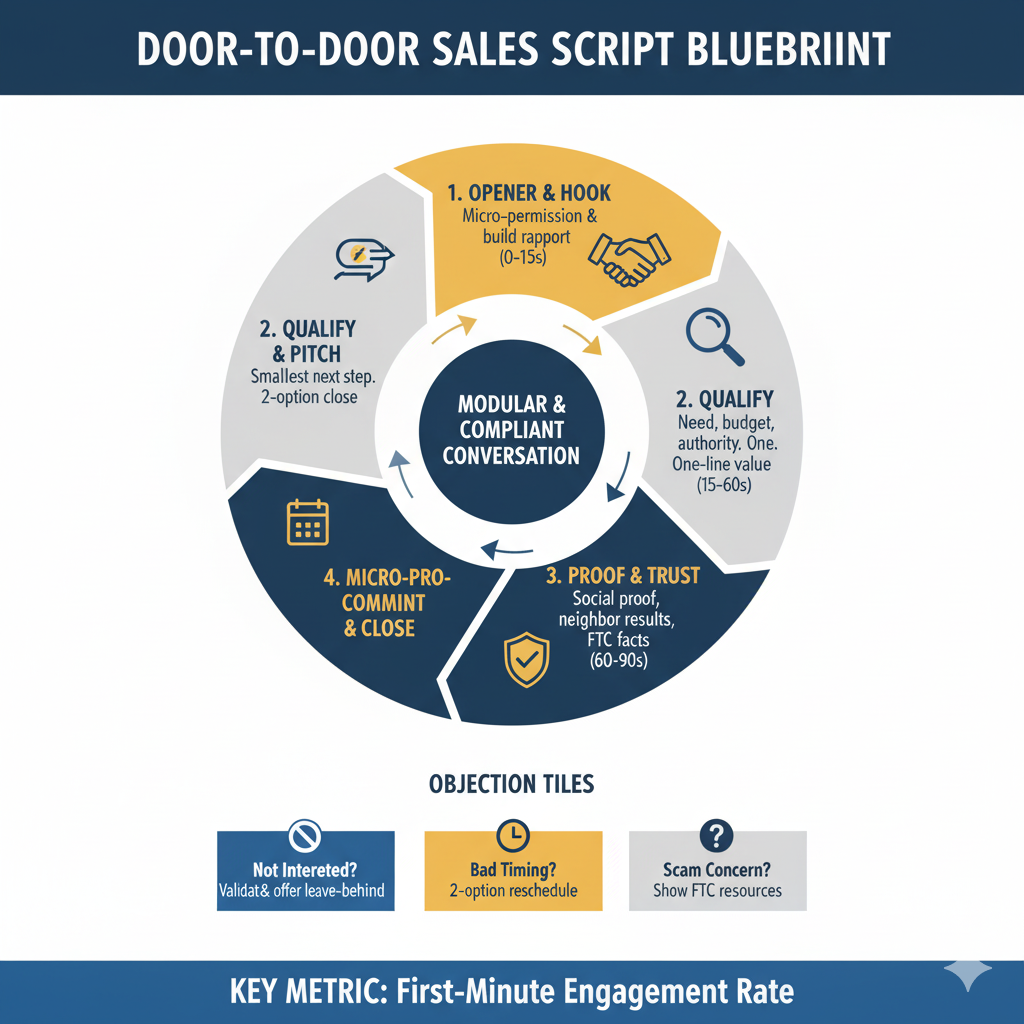
The opener (0–15 sec)
Break the pattern. Lower the guard.
“Hi, quick one, I’m the [role], helping neighbors reduce [specific pain] this month. If I’m interrupting dinner, I can be gone in ten seconds—fair?”
This micro-permission respects their time and lowers their guard immediately.
Fast qualification (15–45 sec)
Get to the point—is this a buyer?
- Buyer fit: “Are you the person who handles [utility/service] for the home?”
- Context check: “Have you noticed current [pain indicator] like high summer bills or [pest issue] lately?”
One-line value prop (45–60 sec)
Be sharp and compelling.
“Most neighbors switch because [specific benefit] without changing [sensitive thing].”
Back it up with one statistic or local proof.
Social proof and authority (60–90 sec)
Build immediate confidence.
“We follow FTC rules and leave your 3-day cancel notice and itemized quote.”
Say it, show it. If relevant, reference government consumer guidance resources.
Micro-commitment ask (90–120 sec)
Reduce friction; ask for the smallest possible next step.
“Two minutes to check [bill/model/issue] and see if you qualify—if not, I’ll be out of your hair.”
This respects their autonomy.
Objection handling tiles
- “Not interested”: Acknowledge, clarify their driver (is it price, timing, or risk?), and offer your compliant leave-behind.
- “Bad timing”: “Understood—should I pop back tomorrow at 6:30 or Saturday at 10?” This is a two-option close.
- “Scam concern”: Present government resources and explain how to verify your credentials.
Transition to set
“If the numbers don’t pencil, please use the 3-day cancel—we only want wins.”
This signals confidence and removes the last ounce of risk aversion.
Comparison table
| Script approach | Use when | Strengths | Risks | Compliance must-haves |
| Rigid script | Large teams, new reps | Easy onboarding | Sounds robotic; brittle to objections | Must include cancel rights and disclosures in leave-behind (Federal Trade Commission) |
| Modular framework | Mixed segments | Adaptable; human | Requires training | Consistent disclosure phrasing and documented handouts (Federal Trade Commission) |
| Consultative flow | Complex products | Trust building; higher set quality | Longer first touch | Reference official consumer guidance in proof pack (U.S. Department of the Treasury) |
Real World Scenarios
- High bill spike month: Open with a cost-containment angle and show a government guide resource to appear impartial.
- Skeptical neighborhood: Lead with compliance and the right-to-cancel. Leave the FTC link on your card.
- Time-crunched block: Use a 60-second micro-pitch; practice with AI to tighten lines.
3 Quick Door-to-Door Sales Pitch Examples That Actually Work
Fast, natural door-to-door scripts including a pest sales script, solar sales pitch, and alarm system sales pitch—easy to plug into any sales workflow.
1. Pest Control
“Hey! We’re treating a few of your neighbors today for ants and spiders. Since we’re already on the street, we’re doing a quick pest sales script route discount for any home we can add.
If you’ve seen bugs around the foundation, I can show you the trouble spots real fast. Want me to take a quick look?”
2. Solar
“Hey! I’m just checking which homes qualify for the new incentives. This is a simple solar sales pitch—not selling anything at the door—just checking usage and giving a quick savings estimate.
If the numbers don’t look good, I’ll tell you. Want me to run a quick roof check?”
3. Alarm Systems
“Hi! We’re upgrading a few homes nearby after the recent break-ins. This is a straightforward alarm system sales pitch with a neighbor discount since our techs are already here.
I can show you in 30 seconds how the system alerts you and the police. Want a quick demo?”
Fewer “try again tomorrow” days
Quick bites, real scripts, instant answers (for free)
Action — convert readers into implementers
Ready to stop wasting sets on rigid, non-compliant scripts? Here’s the rollout plan to transition your team to a high-trust, high-conversion modular framework.
7-step rollout plan
- Define segments and common pains; map your openers per segment.
- Assemble the compliance kit: Get your cancel-notice forms, disclosures, and licenses ready.
- Build the modular script: Opener → qualify → one-line value → proof → micro-ask → objection tile → set.
- AI drill camp: Record and score the first 90 seconds of every rep’s pitch. Cut all filler words.
- Proof pack: Create a simple one-pager with neutral links (DOE, Treasury/FTC).
- Field test on two blocks; log every objection and revise your objection tiles weekly.
- Measure: Track contact-to-set rate, first-minute engagement, and post-sale cancel rate.
Metrics dashboard to track weekly
The key metrics are those that indicate early engagement and compliance risk:
- First-minute engagement rate (door still open after 60s).
- Qualified set rate per 10 doors.
- Cancel rate within 3 business days; investigate root causes.
- Objection frequency map (track top 5).
- Compliance QA: percentage of calls with the proper leave-behind issued.
Compliance checklist
- Present the 3-day right to cancel for covered transactions over $25 and leave written notice.
- Avoid deceptive or unverifiable claims; reference neutral resources when asked.
FAQs
What makes a good opener for a door to door sales script?
A respectful pattern-break, a clear benefit cue (e.g., saving money), and a micro-permission to continue for just 10–15 seconds.
How do I build trust in the first minute without oversharing?
Mention cancel-rights early, show a proof pack, and cite neutral government resources (like the FTC) instead of making unverifiable marketing claims.
What if the homeowner raises scam concerns?
Acknowledge the concern, present FTC/Treasury guidance, and explain the clear verification steps your company provides; never pressure them to continue.
How do I reduce cancellations after close?
You must align expectations, document the terms clearly, leave the cancel-notice front and center, and avoid exaggerated savings or outcome claims.
What metrics matter most early on?
The most important metrics are first-minute engagement, qualified set rate, and the post-sale cancel rate (which indicates compliance and expectation alignment).
Where can I find neutral info to answer technical questions?
Look to DOE homeowner guides for technical product categories (like solar) and FTC consumer alerts for guidance on claims and scams.
JP Arlie is a seasoned professional with a remarkable 30-year career in the direct sales industry. He has achieved significant milestones, leading organizations responsible for over 300,000 in-home sales transactions and recruiting more than 40,000 sales representatives.
JP’s versatile journey in the direct sales field has seen him take on various roles, from business owner to Vice President in a publicly traded company. One of JP’s core values is his commitment to positively impact the lives of others and change the course of history. Additionally, JP serves as an esteemed Executive Education Coach at Harvard Business School’s Program for Leadership Development.
JP Arlie specializes in vital areas, including recruiting and retention strategies through effective systems and processes. His insights have proven instrumental in helping businesses of all sizes build and maintain high-performing sales teams. Furthermore, he excels in guiding organizations through the process of meaningful organizational change.