

Summary
Valuing a pest control business depends on factors like steady recurring revenue, long-term customer contracts, and efficient operations. A strong client base, well-maintained assets, and a good reputation add value. Typically, businesses are valued at 2.5× to 4.5× their earnings. Buyers focus on customer retention and growth potential, while sellers should ensure clean financials and streamlined operations. Understanding these factors helps in making an informed decision, whether buying, selling, or evaluating the business.
Thinking of Selling Your Pest Control Business? Here’s What You Need to Know
Running a pest control business takes hustle, but when it comes time to sell, figuring out what it’s worth can feel like a whole new ballgame. Maybe you’ve built a thriving business with loyal customers and recurring revenue, or you want to offload operations and cash in on years of hard work.
Knowing how to value a pest control business correctly ensures you don’t leave money on the table.
The U.S. pest control industry is projected to hit $42.5 billion by 2032, making it one of the most lucrative service sectors. Buyers are out there—whether investors looking to enter the space, larger pest control companies wanting to expand, or a competitor eyeing your market share.
But you can’t get the best deal without understanding what drives valuation and how to position your business for maximum worth.
This guide will break down:
- The key factors that influence the value of a pest control business
- Common valuation methods buyers use
- How to prepare your business for a sale
- Negotiation strategies to ensure you get a fair deal
Factors That Impact Your Pest Control Business’s Value
Not all pest control companies are worth the same. Buyers assess businesses based on financial health, operations, customer base, and growth potential. Here’s what matters most:
1. Revenue & Profitability: The Bottom Line Matters
Buyers want to see consistent revenue growth and strong profit margins. Recurring revenue from ongoing service contracts is especially attractive. The more predictable your cash flow, the higher your valuation.
📊 Industry Benchmark: Pest control businesses typically sell for 2.5x to 4.5x their EBITDA (Earnings Before Interest, Taxes, Depreciation, and Amortization). Companies with higher profit margins or strong regional dominance can command even higher multiples.
2. Recurring vs. One-Time Customers
A business with a solid base of recurring customers is more valuable than one reliant on one-time treatments. Why? Because it guarantees future revenue.
🔹High Value: Companies with monthly, quarterly, or annual service contracts
🔹Lower Value: Businesses that mostly handle one-off jobs (e.g., termite tenting, emergency rodent removal)
3. Customer Base & Contracts
The quality and diversity of your customer base affect valuation. You’ll attract more buyers if your business serves a mix of residential, commercial, and industrial clients.
🔹High Value: Long-term commercial contracts (restaurants, hotels, warehouses)
🔹Lower Value: Businesses overly dependent on a few large clients (buyer risk if they leave)
4. Geographic Location & Market Demand
Pest control is a location-dependent industry. Areas with high pest activity, strict health regulations, or year-round service needs (e.g., Florida, Texas, California) typically yield higher valuations.
📍Hot Markets: Dense urban areas with large commercial sectors
📍Challenging Markets: Low-density rural areas with seasonal service fluctuations
5. Operational Efficiency & Assets
Buyers don’t just purchase revenue—they buy efficiency. Streamlined operations, automated systems, and a skilled workforce increase business value.
✅ Well-maintained service vehicles
✅ Modern CRM & scheduling software (buyers love AI-driven automation)
✅ Trained technicians under long-term employment contracts
According to Thomas Lundberg (CEO of Sellify), AI-driven outbound sales and automation tools are transforming the pest control industry by increasing efficiency and revenue per technician. Your business has an edge if it uses tech-like AI-driven customer engagement.
6. Reputation & Brand Strength
Online reviews matter more than you think. To gauge brand strength, buyers look at Google ratings, social media presence, and word-of-mouth reputation. A 5-star business with a strong local presence is significantly more valuable than a company with poor reviews or no online footprint.
Read Also “Sales Bootcamp“
How to boost valuation?
How to boost valuation?
- Collect and showcase customer testimonials [source: D2D Experts]
- Improve Google My Business listing and optimize for local SEO
| Factor | Impact on Value |
| Revenue & Profitability | Consistent, recurring revenue increases business worth. |
| Customer Base & Contracts | Diverse, long-term customers and contracts are more valuable than one-time jobs. |
| Operational Efficiency | Efficient systems and tech automation increase value by reducing costs. |
| Reputation & Brand Strength | Strong online reviews and a good local reputation increase buyer interest. |
| Geographic Location | High-demand areas (e.g., Florida, Texas) tend to increase valuation. |
Real-World Scenario: How Tech-Driven Strategies Boosted Efficiency for a Pest Control Business
Let’s explore how GreenWave Pest Control, a mid-sized pest control company in Florida, transformed its operations and increased revenue by embracing AI-driven sales and automation tools. This case study highlights the significant improvements that technology can bring to a traditionally labor-intensive industry.
The Challenge:
GreenWave was facing challenges with inconsistent revenue and inefficient manual processes. They relied on traditional sales methods, with their sales team manually handling inbound leads and cold calling. Despite offering quality services, customer retention was low, and the company had only a handful of long-term contracts.
The Solution:
To address these issues, GreenWave decided to implement AI-powered tools to streamline their operations:
- AI-Driven Sales: The company adopted an automated AI platform that reached out to potential customers with personalized messages, re-engaging previous leads and upselling additional services.
- Automated Scheduling & CRM Integration: They integrated a new CRM system that synced with scheduling software, automating follow-ups and reminders for customers.
- AI-Powered Customer Retention: GreenWave set up automated systems to send reminders, schedule services, and offer incentives for customers to renew contracts.
The Results:
- Increased Revenue: Within just six months, GreenWave saw a 25% increase in recurring service contracts. They successfully upsold services like mosquito control and termite inspections, which led to an 18% growth in their customer base.
- Improved Efficiency: The AI system helped the sales team close 30% more leads, with the automation handling routine follow-ups, allowing the team to focus on high-value prospects.
- Better Customer Retention: Automated reminders and personalized engagement led to a 40% increase in customer retention, resulting in more long-term contracts and steady income.
Takeaway:
GreenWave’s experience shows how leveraging AI-driven sales and automation tools can significantly improve efficiency, boost revenue, and enhance customer retention. For any pest control business looking to scale, adopting smart technology solutions is essential. Whether it’s improving customer engagement or streamlining operations, technology can give your business a competitive edge in a crowded market.
In 20 minutes, we’ll spot your biggest blockers and hand you a one-page action plan (recruiting, training, ops, KPIs)
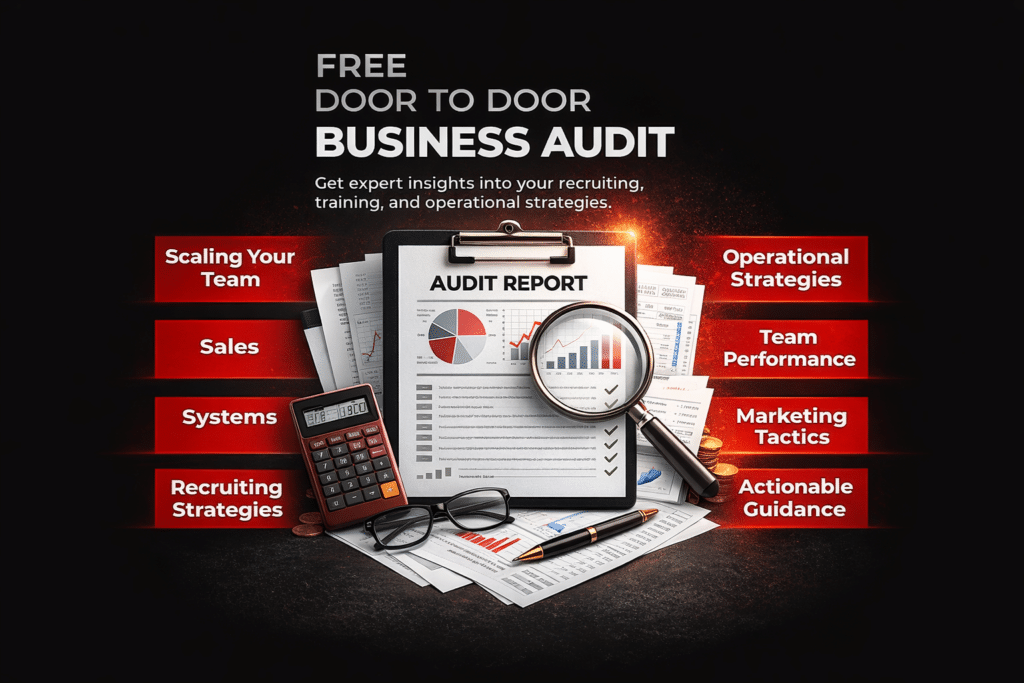
Punch in your info and book an appointment!
You’ll walk away with:
- A quick read on set → sit → close and team capacity
- 3 fixes to deploy in the next 30 days
- A simple cadence + scorecard to keep reps accountable
Used by top D2D owners in Solar, Roofing, Pest & Alarms.
Common Valuation Methods
There’s no single way to value a business, but these are the three most common:
1. Market-Based Valuation
1. Market-Based Valuation: What’s the Going Rate?
This method compares recent sales of similar pest control businesses in your market, adjusting for size, revenue, and customer contracts. Think of it like checking home prices before selling your house.
| Example: If a pest control company in your city with similar revenue and service offerings sold for 3.5x EBITDA, your business could fetch a similar multiple—but only if your customer retention and profitability are just as strong. |
Look beyond the surface—businesses with high contract retention (recurring revenue) and strong brand reputation consistently sell for a premium. If your competitors are getting higher multiples, analyze why. Are they bundling services? Offering better financing options? Investing in D2D sales training like D2DU Pest to boost their close rates? These small tweaks add up to big valuation bumps.
2. Income-based valuation
This is the gold standard for serious buyers. Investors want to know how much cash flow the business generates and how predictable that revenue stream is. The most common formula is:
📊 Business Value = EBITDA × Industry Multiple (2.5x–4.5x)
| Example: Let’s say your pest control business generates $500,000 in EBITDA (Earnings Before Interest, Taxes, Depreciation, and Amortization). If similar businesses sell at 4x EBITDA, your estimated valuation is $2 million. |
Why Do Some Businesses Get a Higher Multiple?
A company valued at 4.5x EBITDA likely has:
✔ A high percentage of recurring revenue from quarterly service contracts.
✔ Strong brand positioning and local market dominance.
✔ Operational efficiencies—AI-driven scheduling, automated customer follow-ups, and optimized routing.
✔ A well-trained sales team consistently closing high-value deals (hint: D2DU Pest training sharpens these skills).
On the flip side, if your customer base consists mostly of one-time jobs and your churn rate is high, expect the lower end of the multiple scales—or worse, buyers may not be interested.
3. Asset-Based Valuation
If your business owns real estate, vehicles, equipment, and valuable contracts, these assets might be factored into the valuation. However, most pest control businesses derive their true worth from recurring revenue, making this method less common.
Example:
Let’s say your company owns:
✔ $500,000 in service trucks
✔ $100,000 in office equipment
✔ $200,000 in chemical inventory
That’s $800,000 in tangible assets, but if your customer contracts generate $2 million annually, an asset-based approach wouldn’t reflect your business’s true market value.
| Valuation Method | Description | Common Use |
| Market-Based Valuation | Compares recent sales of similar pest control businesses in the market. | Often used for quick estimations based on similar business sales. |
| Income-Based Valuation | Calculates business value by multiplying EBITDA by an industry multiple (2.5×–4.5×). | Commonly used by serious buyers to assess future cash flow potential. |
| Asset-Based Valuation | Based on the value of tangible assets like vehicles, equipment, and real estate. | Used when assets play a significant role, though less common in pest control. |
This workbook turns new reps into pest quota killers
Enter your info, and we’ll drop it in your inbox
Steps to Value a Pest Control Business
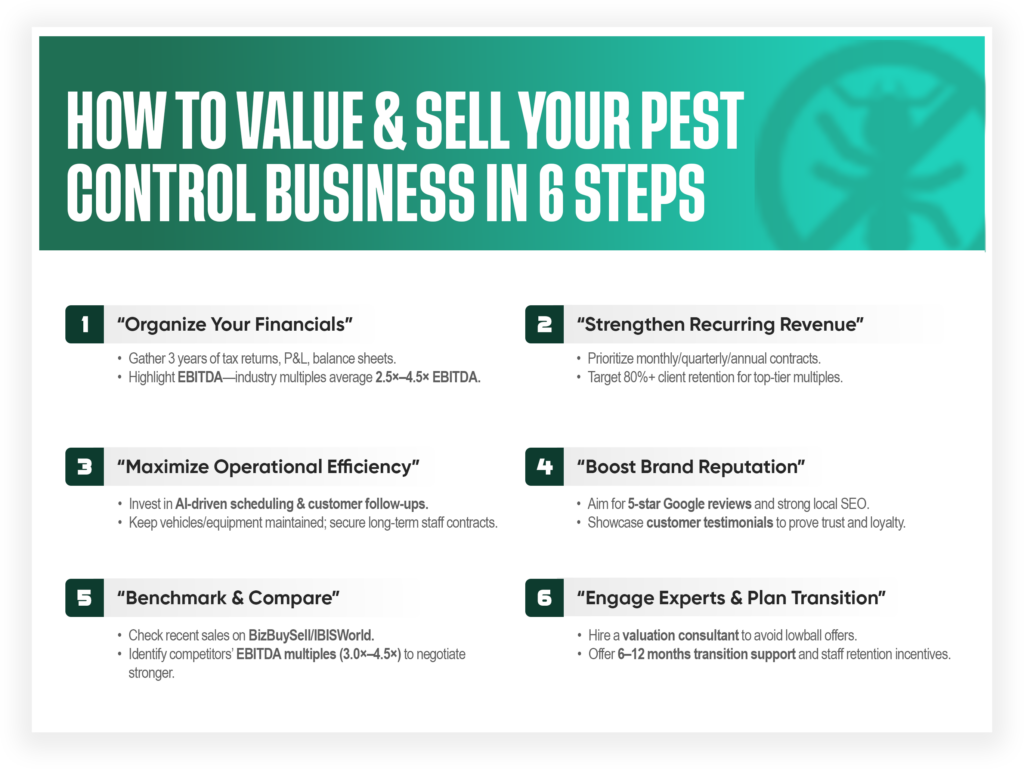
1. Gather Financial Records and Performance Metrics
No serious buyer will even entertain an offer if your books are messy. Get your numbers tight before going to market.
✅ Past 3 Years of Tax Returns – Buyers want to see trends, not just last year’s success.
✅ Profit & Loss Statements – Show revenue, expenses, and EBITDA.
✅ Balance Sheets – Assets, liabilities, and equity position.
✅ Customer Contracts & Retention Data – Recurring revenue is golden in valuation.
Pro Move: Use accounting software or hire a consultant from D2D Experts to clean up your financials and ensure you maximize your valuation before listing your business.
2. Evaluate Operational Efficiencies and Recurring Revenue
A business with solid systems, automation, and well-trained employees is far more attractive to buyers than one that relies on the owner to keep things running.
🔹 Why Buyers Pay More for Operational Efficiency:
✔ Low employee turnover = stability = higher value.
✔ AI-driven customer retention strategies (automated scheduling, follow-ups) reduce churn and increase contract renewal rates.
✔ Well-documented SOPs (Standard Operating Procedures) show that the business runs without you—exactly what buyers want.
Example: Companies investing in AI-driven customer retention strategies—like automated text follow-ups and predictive scheduling—outperform competitors in both valuation and sales multiples【source: D2D Experts Pest Sales Consulting】.
3. Compare with Industry Benchmarks and Market Trends
Knowing what similar businesses have sold for in your market will strengthen your negotiating position.
📊 Use industry sales databases like BizBuySell or IBISWorld to analyze recent pest control business sales.
📈 Look at market trends—eco-friendly services and AI-enhanced customer management are increasing valuations.
Pro Move: If your valuation isn’t where you want it to be, consider D2D Business Bootcamp to refine your sales strategies, streamline operations, and scale revenue before selling.
4. Consult with a Business Valuation Expert
If you’re serious about selling, don’t guess your value. Hire a valuation expert to avoid lowball offers and negotiate from a position of strength.
✔ Experts know what buyers look for.
✔ They help you structure deals to maximize profits.
✔ They can guide you on when to sell for the best return.
📢 Thinking of selling? The D2D Experts Consulting Team specializes in helping pest control business owners get top dollar. Don’t leave money on the table.
Key Considerations for Buyers and Sellers
1. How Buyers Assess Risk and Growth Potential
Before writing a check, buyers analyze:
✔ Customer retention rates – If your business retains 80%+ % of clients, you command a higher multiple.
✔ Growth potential – Can they expand into new territories or upsell existing clients (e.g., adding mosquito control)?
✔ Employee contracts & training – A well-trained, long-term sales team reduces risk.
🚀 Pro Move: Buyers love businesses without the owner’s daily involvement. If you’re still too hands-on, consider D2D Business Bootcamp to build a more self-sufficient operation.
2. Negotiation Strategies for a Fair Deal
🔹 Never accept the first offer—buyers expect negotiation.
🔹 Structure deals with earnouts (get paid based on future revenue).
🔹 Highlight growth opportunities (upselling, AI automation, bundling services).
🔥 Example: Instead of a straight sale, some owners negotiate to keep a minority stake—allowing them to cash out while still benefiting from future growth.
3. Transition Planning for New Ownership
A smooth transition maintains business value and reassures customers. Offer:
✔ 6-12 months of owner consultation for the buyer.
✔ Employee retention incentives to prevent mass exodus.
✔ Sales & service training for new management (consider D2DU Pest Training for a seamless transition).
Final Thoughts: How to Sell Your Pest Control Business for Maximum Value
Selling a pest control business is about more than numbers, its about packaging your company to attract the right buyers and maximize your sale price.
✅ Keep financials clean and well-documented
✅ Boost recurring revenue with long-term contracts
✅ Invest in operational efficiency and AI-driven automation
✅ Market your business’s growth potential and competitive advantage
Whether you’re preparing to sell now or just want to understand your business’s worth, these steps will ensure you get top dollar when the time comes.
Key Takeaways:
- Recurring revenue boosts value with long-term contracts providing stability.
- Operational efficiency and a good reputation enhance business worth.
- Valuation multiples typically range from 2.5× to 4.5× EBITDA.
- Customer retention is crucial for increasing business value.
- Prepare for sale by organizing financials and streamlining operations.
Frequently Asked Questions
1. How is a pest control business valued?
A pest control business is valued based on recurring revenue, customer base, operational efficiency, and assets. The most common methods are market-based valuation, income-based valuation using EBITDA multiples (2.5×–4.5×), and asset-based valuation.
2. What factors impact the value of a pest control business?
Key factors include steady revenue, long-term customer contracts, operational efficiency, brand reputation, and location. Businesses with recurring contracts and diverse clients are more valuable.
3. Why is recurring revenue important for valuation?
Recurring revenue provides predictable cash flow, making the business more stable and attractive to buyers, leading to higher valuation.
4. What are the most common methods used to value a pest control business?
The three common methods are market-based valuation, income-based valuation (EBITDA × multiple), and asset-based valuation. Income-based valuation is the most common.
5. How can I increase the value of my pest control business before selling?
Increase recurring revenue, streamline operations, improve brand reputation, and ensure clean financial records to boost your business value.
6. What role does customer retention play in the sale of a pest control business?
High customer retention increases stability, making the business more attractive to buyers and leading to a higher valuation.
7. How should I prepare for selling my pest control business?
Prepare by organizing your financial records, streamlining operations, and consulting a business valuation expert to ensure you get the best price.