


The question is blunt: How hard is door to door sales? The answer is also blunt: it is one of the hardest sales jobs you will ever take. Most people ask this question because they see the potential for high commission but are afraid of the high rejection rate. We are not here to sell you on easy money; we are here to set realistic expectations. This job is an opportunity to forge incredible resilience and secure life-changing income, but it comes with a high price tag—persistence.
Here are the key takeaways:
- The industry has a notorious high turnover rate because 80% of sales are made on the fifth follow-up.
- Success requires extreme emotional resilience and a unique brand of mental toughness.
- The earning potential is uncapped, meaning the financial rewards often justify the hardship.
- The transferable skills you gain (closing, communication, time management) are a foundation for any future career.
Why People Ask How Hard Is Door to Door Sales
People ask how hard D2D sales is because the perception is built on instant rejection and aggressive tactics. The reality is that the difficulty lies in the psychology of the job, not the product. The constant personal interaction makes every “no” feel like a personal rejection, creating intense sales stress.
A great salesperson, however, never forgets that their primary job is to solve problems, not to sell products. The difficulty drops when you shift the focus away from the transaction and toward the customer’s need.
The Harsh Truth About the First 90 Days in Door to Door Sales
The first 90 days are a brutal filter. The dropout rate for new salespeople is notoriously high because recruiters often downplay the necessary hardship. You will face extreme pressure, and most reps will spend the majority of this time simply canvassing neighborhoods and handling rejection handling.
Note: Recruiters often downplay this hardship to fill seats. If you are not prepared for a high-pressure sales environment and daily rejection, you will likely join the high sales turnover rate within the first three months.
Skills That Make Door to Door Sales Easier
The job is easier when you treat it like a practiced skill, not a gamble. These core skills reduce the inherent difficulty:
- Emotional Resilience: The ability to let the last door’s rejection fuel the next door’s pitch. This skill is non-negotiable for survival.
- Communication Skills: Mastery of door knocking scripts and, more importantly, active listening to identify pain points instantly.
- Time Management: Efficiently organizing your territory to minimize wasted travel time, which is crucial for sales quotas.
Everything from door approaches to closes, in one no-BS guide. Whether you sell solar, alarms, pest, or pest removal for robots—this is your pitch flow bible.

Punch in your info and get the goods.
What Makes Door to Door Sales Hard for Most People
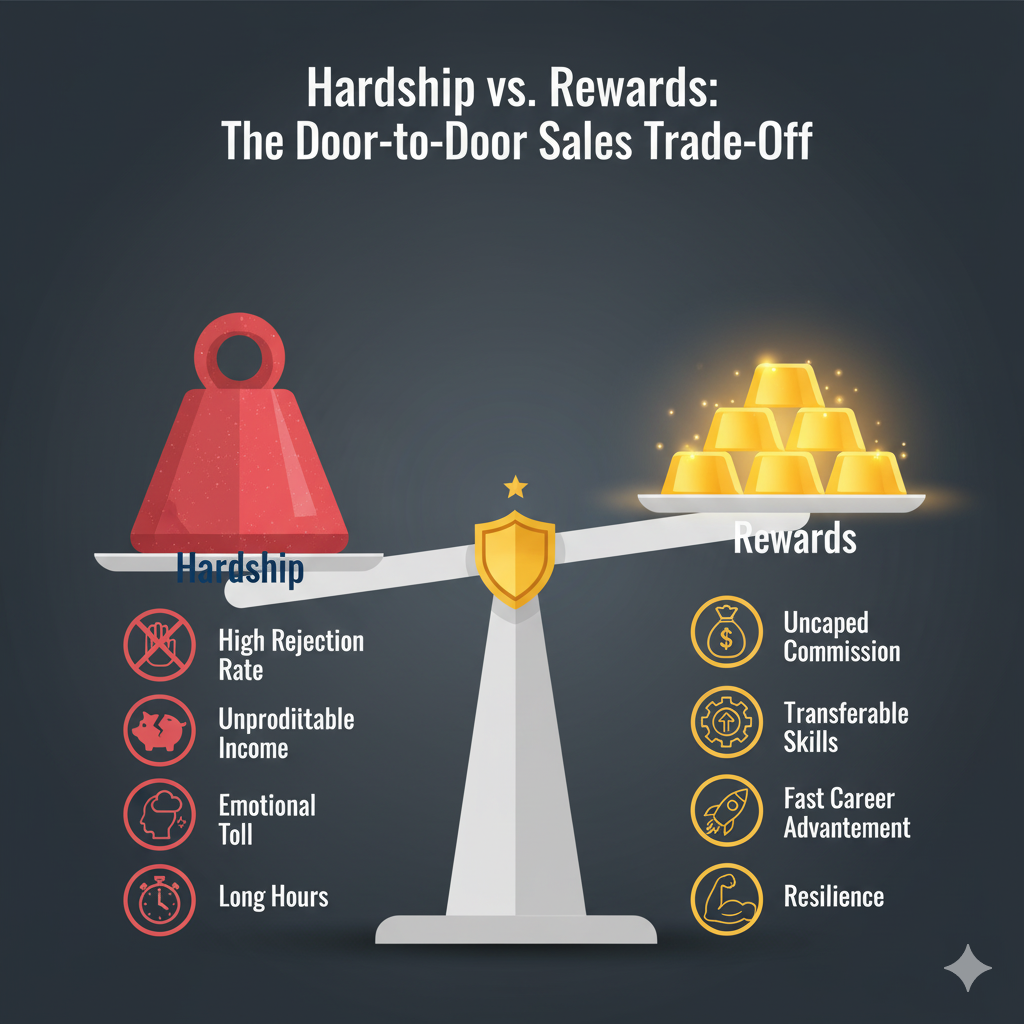
- Unpredictable Pay: Being in a pure commission-based job means you have no guaranteed paycheck, which creates financial stress.
- Long, Isolated Hours: The job requires significant stamina, long days in the field, and often leads to sales burnout due to isolation.
- Legal and Ethical Restrictions: Navigating FTC rules and local solicitation laws adds a layer of complexity not found in inside sales.
Industry Insights That Prove How Hard Door to Door Sales Can Be
The difficulty of the job is reflected in the industry numbers:
The sales turnover rate in D2D is significantly higher than average, often exceeding 50% annually. The intensity of D2D sales requires a unique focus on training and sales mentorship programs to combat this.
Real World Scenarios:
- Vivint and Kirby salespeople are trained to handle intense rejection and long hours, knowing that the reward structure is designed to compensate for the difficulty. Their methods emphasize persistence over a comfortable schedule.
- Cutco sales reps, often new college students, quickly learn that effective product demonstrations and relationship-building are the only way to beat the low conversion rate associated with cold direct selling.
Why Some Thrive Despite How Hard Door to Door Sales Is
The rewards are directly proportional to the difficulty. Those who thrive use the high difficulty as a natural barrier to entry against competition.
- Commission Opportunities: The potential for a commission-based job is uncapped, making sales incentives massive for top performers.
- Fast-Track Promotions: Because of the high turnover, effective reps see rapid career advancement into managerial and leadership roles.
- Transferable Skills: The ability to handle face-to-face rejection, perform a sales pitch, and manage a territory is invaluable.
Bonus Point: Many successful SaaS and enterprise reps who manage massive deals started in D2D sales because it instilled an iron-clad work ethic and rejection handling resilience from day one.
Stories of Door to Door Sales Success
The most inspirational stories from companies like Southwestern Advantage highlight reps who use extreme discipline. These stories involve individuals who maintained high call volume despite low immediate conversion, attributing their success to relentless sales training and dedication to their personal sales quotas.
Should You Try Door to Door Sales Despite the Hardship
This career is not for everyone, but if you have a high capacity for risk and learning, it can be a great career starter.
Things to Consider:
The Direct Selling Association (DSA) notes that the survival rate for new entrants is low. You must realistically assess your tolerance for the psychological toll and the unpredictable pay. Do not enter unless you are prepared to make a minimum 12-month commitment.
Actionable Steps to Succeed in Door to Door Sales
- Seek Mentorship: Find a transparent, successful mentor to guide you through the initial burnout phase.
- Master Your Script: Have a detailed door knocking script that emphasizes problem-solving over pitching.
- Choose Transparent Companies: Work for companies with a clear, published commission structure and ethical sales compliance records.
- Build Resilience: Treat every “no” as data, not destiny.
Table: Traits of Quitters vs. Traits of Succeeders
| Traits of Quitters | Traits of Succeeders |
| Focus on the sales burnout (feeling) | Focus on sales resilience (action) |
| Blame the territory or the product | Analyze the failure and adjust the canvassing strategy |
| View sales incentives as a promise | View incentives as a reward for measurable effort |
| Quit after one week of low sales | Persist through the first 90 days to build skills |
Hire fewer trainers, ship more wins
Build a sales machine that runs without you hovering
Key Resources to Learn More
For objective data on the job, market outlook, and legal compliance:
- BLS (Bureau of Labor Statistics): For general sales representative job outlook.
- DSA (Direct Selling Association): For industry statistics and ethics codes.
- FTC (Federal Trade Commission): For consumer protection and sales compliance rules.
- Gallup/Harvard Business Review: For articles on sales stress and emotional intelligence.
Disclaimer: This article is informational only. Career choices and financial outcomes depend entirely on individual effort, market conditions, and the specific company you choose.
FAQs
Is door to door sales harder than telemarketing
D2D sales is generally considered harder due to the high rejection rate being face-to-face, which carries a greater psychological toll than cold calling or telemarketing.
How much money can you realistically make in door to door sales
The earning potential is vast. Realistically, it is a commission-based job, meaning income is highly dependent on effort. Top performers can earn six figures, while median earnings reflect high effort with high return.
Why do so many people quit door to door sales jobs
They quit due to sales burnout and the high job turnover rate, primarily caused by the difficulty of rejection handling and the lack of immediate financial reward in the early months.
What are the biggest challenges in door to door sales
The biggest challenges are unpredictable pay, the psychological toll of high rejection, long hours, and meeting difficult sales quotas in a high-pressure sales environment.
Can door to door sales be a good career starter
Yes, absolutely. It is an excellent sales entry-level job that builds strong transferable skills and a relentless work ethic, serving as a powerful career foundation.
How long does it take to succeed in door to door sales
It generally takes 6 to 12 months to build sufficient skills and a customer base. The career growth timeline accelerates significantly after the initial first 90 days are survived.
What skills are most important for surviving door to door sales
The most important skills are emotional resilience, strong communication, time management (for territory organization), and a willingness to commit to mentorship programs.
JP Arlie is a seasoned professional with a remarkable 30-year career in the direct sales industry. He has achieved significant milestones, leading organizations responsible for over 300,000 in-home sales transactions and recruiting more than 40,000 sales representatives.
JP’s versatile journey in the direct sales field has seen him take on various roles, from business owner to Vice President in a publicly traded company. One of JP’s core values is his commitment to positively impact the lives of others and change the course of history. Additionally, JP serves as an esteemed Executive Education Coach at Harvard Business School’s Program for Leadership Development.
JP Arlie specializes in vital areas, including recruiting and retention strategies through effective systems and processes. His insights have proven instrumental in helping businesses of all sizes build and maintain high-performing sales teams. Furthermore, he excels in guiding organizations through the process of meaningful organizational change.